The Benefits of Professional Asbestos Removal: What the Evidence Shows
Every year, homeowners search for ways to cut costs on asbestos work. Some succeed. Others disturb fibres that settle into their home's fabric and remain there for decades. This article sets out — with data — what professional removal actually delivers and what DIY cannot.
The UK banned asbestos in 1999, but the material remains in an estimated 1.5 million buildings — most of them homes built before that date. When those buildings are renovated, extended, or demolished, the question of how to handle the asbestos inside them becomes unavoidable. The answer, in most cases, is straightforward: use a licensed contractor. The question worth exploring is why.
The Health and Safety Executive recorded 2,218 mesothelioma deaths in 2023 — the most recent year for which full data is available.[1] Mesothelioma is caused almost exclusively by asbestos exposure. The disease has a latency period of 20 to 60 years, which means the people dying today were exposed in the 1960s, 1970s, and 1980s, when asbestos was still being installed in homes, schools, and offices across the country. The decisions made during renovation work today will determine whether that toll continues beyond 2050.
Professional removal is not simply a regulatory requirement. It is the only method that reliably contains fibres, verifies the result, and creates a permanent record that the work was done correctly. The six benefits below explain exactly how — and what the data shows about the alternative.
What Professional Asbestos Removal Actually Involves
Before any material is touched, a licensed contractor carries out a refurbishment or demolition survey to confirm the location, type, and condition of all asbestos-containing materials (ACMs). For most domestic projects, a management survey will already have identified the materials; the refurbishment survey provides the detailed information needed to plan the removal safely.
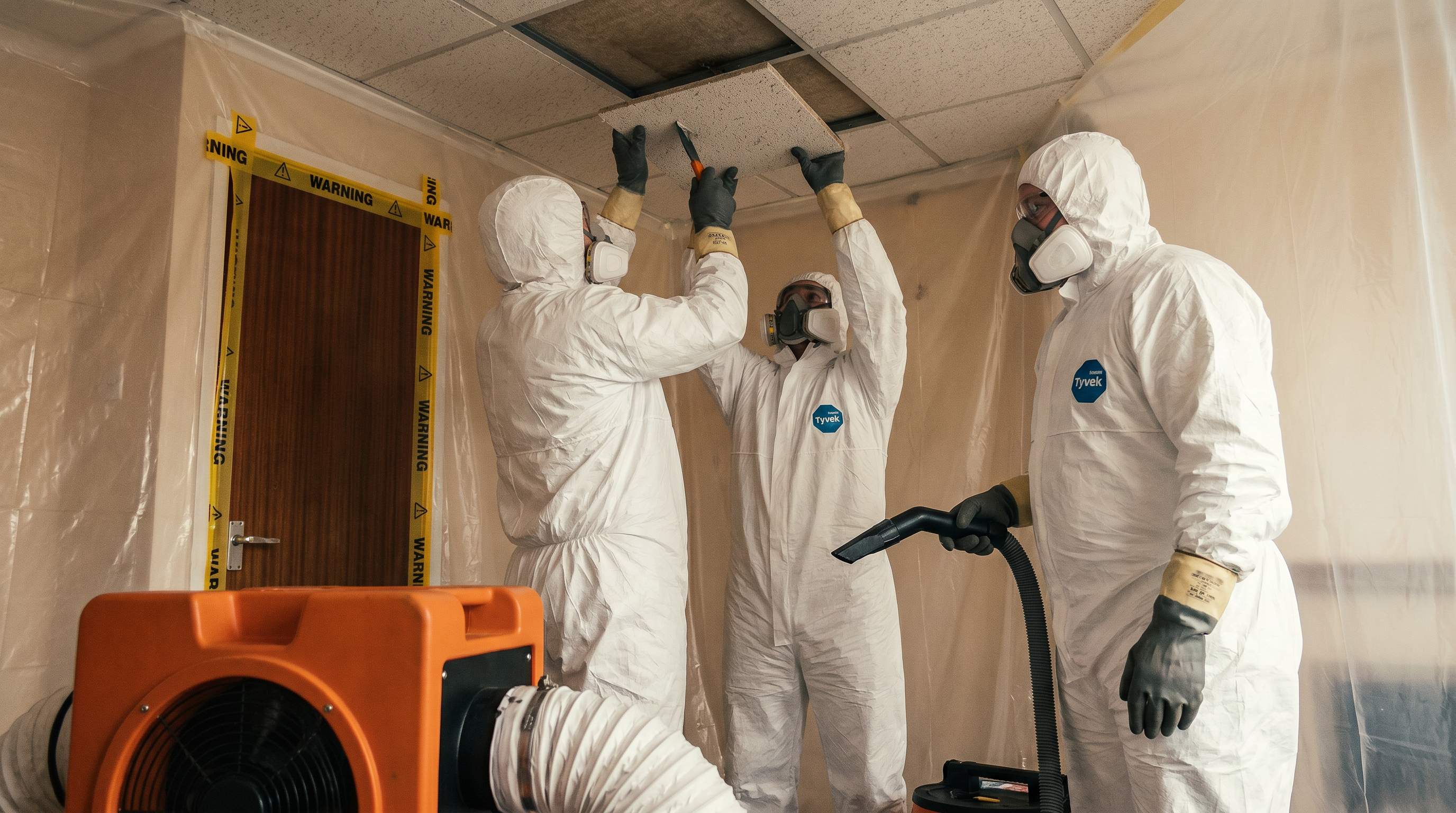
The removal itself follows a strict sequence. The work area is isolated with polythene sheeting and negative air pressure equipment. Workers wear full PPE — Type 5/6 Tyvek suits, P3 half-mask or full-face respirators, and double-layer nitrile gloves. Materials are wetted before removal to suppress fibre release, then double-bagged in UN-approved red asbestos sacks. The area is thoroughly cleaned using H-class vacuum equipment and wet wiping before the independent analyst carries out the four-stage clearance procedure set out in HSG248.[3]
That four-stage clearance — visual inspection, background air test, post-cleaning visual inspection, and final air test — is what separates licensed removal from every other approach. It is not a formality. It is the mechanism by which the result is independently verified. Want to understand the full process in detail? Read our guide to asbestos regulations and your legal obligations.
Six Benefits That Matter
Fibre Containment You Cannot Replicate at Home
Licensed contractors erect a fully sealed decontamination unit (DCU) with negative air pressure before a single tile is touched. Air is drawn through H14 HEPA filters rated to capture particles down to 0.3 microns — smaller than any asbestos fibre. The enclosure is smoke-tested before work begins and maintained throughout. Without this infrastructure, disturbed fibres travel freely through a property's ventilation system and settle on soft furnishings, where they remain for years.
Independent Air Testing at Every Stage
The HSG248 four-stage clearance procedure requires an independent UKAS-accredited analyst — not the removal contractor — to carry out a thorough visual inspection, air sampling, and final clearance certificate before the enclosure is dismantled. Personal air samples taken during licensed removal work routinely return results below 0.01 f/ml, well under the HSE's control limit of 0.1 f/ml. That independent verification is simply not available to a homeowner working alone.
Licensed Disposal with a Full Paper Trail
Asbestos waste is classified as hazardous under the Hazardous Waste Regulations 2005. It must be double-bagged in UN-approved red asbestos sacks, labelled correctly, and transported to a licensed disposal facility under a consignment note. Licensed contractors handle every step of this chain. Homeowners who dispose of asbestos waste incorrectly — including placing it in a skip or taking it to a household waste centre — face fines of up to £5,000 under the Environmental Protection Act 1990.
Full Legal Compliance and Liability Transfer
The Control of Asbestos Regulations 2012 (CAR 2012) requires that licensed asbestos work — which covers the removal of most friable and high-risk ACMs — is carried out only by contractors holding a current HSE licence. Using an unlicensed contractor, or attempting the work yourself, does not transfer liability: if asbestos fibres are later found to have contaminated a neighbouring property or caused illness, the duty holder remains legally responsible. A licensed contractor's insurance and documentation close that gap.
Property Value Protected and Mortgage-Ready
Properties with undisclosed asbestos can lose between 10% and 20% of their market value, according to industry surveys. More practically, many mortgage lenders and surveyors now require evidence of professional removal or a current asbestos management plan before they will proceed. A clearance certificate from a licensed contractor — backed by independent air test results — satisfies both requirements and removes the material from the property's disclosure obligations.
Peace of Mind That Lasts Decades
Asbestos-related diseases have a latency period of 20 to 60 years. A homeowner who disturbs asbestos today may not know whether they were exposed at a dangerous level for another two decades. Professional removal eliminates that uncertainty. The clearance certificate, the waste consignment notes, and the independent air test results together form a permanent record that the work was done correctly — a record that protects the current owner, future buyers, and any tradespeople who work in the property afterwards.
DIY vs Professional Removal: A Direct Comparison
A simulation study published in Occupational and Environmental Medicine measured personal asbestos fibre exposure across nine DIY removal scenarios.[2] The results were striking. Most scenarios produced exposures below the HSE control limit of 0.1 f/ml. But cutting asbestos cement with an angle grinder — a common task when fitting a domestic air-conditioning unit — produced personal exposures of 13.23 f/ml. That is 132 times the control limit. Dry cutting of holes for flue installation returned 2.79 f/ml, still 28 times the limit.
| Factor | DIY Removal | Professional Removal |
|---|---|---|
| Fibre release control | Uncontrolled — fibres spread through property | Sealed DCU with negative pressure and H14 HEPA filtration |
| Personal exposure | Up to 13.23 f/ml with power tools (Benke & Trotman, 2017) | Typically <0.01 f/ml under licensed conditions |
| Air testing | None | Independent UKAS-accredited analyst, 4-stage clearance |
| Waste disposal | Often illegal — skip or household waste | Hazardous waste consignment notes, licensed facility |
| Legal compliance | Likely breach of CAR 2012 for licensable work | Full HSE licence, insurance, and documentation |
| Property disclosure | No clearance certificate — must disclose on sale | Clearance certificate removes disclosure requirement |
| Liability | Duty holder retains full liability | Liability transferred to licensed contractor |
Sources: Benke & Trotman (2017)[2]; HSE CAR 2012[6]; HSG248[3]; Hazardous Waste Regulations 2005[5]
The Property Value Argument
Asbestos in a property does not automatically reduce its value. Properly managed, in-situ ACMs that are in good condition and recorded in an asbestos register are a manageable liability. What does reduce value — sometimes by 10% to 20% — is undisclosed or poorly managed asbestos that surfaces during a buyer's survey.[7][8]
Professional removal changes the equation entirely. A clearance certificate from a UKAS-accredited analyst, backed by waste consignment notes, removes the material from the property's disclosure obligations. Mortgage lenders who previously required a price reduction or retention to cover removal costs will proceed without conditions. Estate agents can market the property as asbestos-free with documentary evidence to support the claim.
There is also a tax angle worth knowing about. Under HMRC's Land Remediation Relief scheme, commercial property owners can claim 150% tax relief on the cost of asbestos removal from contaminated land or buildings. The relief applies to the full cost of surveys, removal, and disposal. For residential landlords, the cost of professional removal is generally allowable as a repair expense against rental income.
When Removal Is Not the Right Answer
Professional removal is not always the correct course of action. The HSE's guidance is clear: asbestos that is in good condition, unlikely to be disturbed, and properly managed in place poses a very low risk. Removing it unnecessarily can actually increase risk by disturbing fibres that would otherwise remain inert.
The decision between management, encapsulation, and removal depends on the material's condition, its location, the likelihood of future disturbance, and the property's planned use. A licensed contractor will assess all four factors and recommend the approach that best balances safety, cost, and long-term risk. Read our detailed guide to encapsulation vs removal for a full breakdown of when each approach is appropriate.
How Pro Asbestos Removal Protects London Households
Pro Asbestos Removal is an HSE-licensed contractor operating across London, Surrey, and the South East. Every project follows the full HSG247 and HSG248 protocols — licensed removal, independent UKAS-accredited clearance testing, and complete post-removal documentation. The team handles everything from a single asbestos garage roof to whole-building commercial abatement programmes.
Frequently Asked Questions
Is professional asbestos removal always required by law?
What does the 4-stage clearance procedure involve?
Can I remove asbestos cement sheets myself?
How long does professional asbestos removal take?
Does professional removal affect my home insurance?
What happens to the asbestos waste after removal?
References
- [1]HSE (2024). Key figures for Great Britain 2024 to 2025. Health and Safety Executive. 2,218 mesothelioma deaths recorded in 2023. Source
- [2]Benke, G. & Trotman, J. (2017). Measurement of asbestos fibre release during removal works in a variety of DIY asbestos removal scenarios. Occupational and Environmental Medicine, 74(Suppl 1), A151. Source
- [3]HSE (2021). HSG248: Asbestos — The Analysts' Guide (2nd ed.). Health and Safety Executive. Sets out the 4-stage clearance procedure for licensed asbestos removal. Source
- [4]HSE (2013). HSG247: Asbestos — The Licensed Contractors' Guide. Health and Safety Executive. Defines licensable work and contractor obligations under CAR 2012. Source
- [5]Hazardous Waste Regulations 2005 (SI 2005/894). Classifies asbestos waste as hazardous and sets consignment note requirements for disposal. Source
- [6]Control of Asbestos Regulations 2012 (SI 2012/632). Requires HSE-licensed contractors for licensable asbestos work and imposes duty to manage on non-domestic premises. Source
- [7]Asbestos-surveys.org.uk (2024). How does an asbestos survey impact the valuation of a property? Reports property value reduction of up to 10% from undisclosed asbestos. Source
- [8]Advance Asbestos Removal (2025). Asbestos and Property Value: How It Impacts Home Sales. Reports value impact of up to 20% for extensive or damaged ACMs. Source
Concerned About Asbestos?
Get a free, no-obligation quote from our HSE-licensed team. We cover all of London, Surrey, and the South East.
020 8157 7797Request a QuoteKey Facts
- 2,218 mesothelioma deaths in 2023 (HSE)
- 1.5 million UK buildings contain asbestos
- CAR 2012 requires HSE licence for licensable work
- 4-stage clearance by independent UKAS analyst
- Property value can fall 10–20% with undisclosed ACMs
- 150% tax relief available for commercial removal
