What Does Asbestos Look Like?
Most asbestos-containing materials look completely ordinary. A grey garage roof, a swirled ceiling, a dark floor tile — none of them announce what they contain. This guide explains what to look for, which materials are most likely to contain asbestos, and why visual inspection alone is never enough.
You cannot confirm asbestos by looking at it. Visual inspection can only indicate which materials are likely to contain asbestos based on age, location, and appearance. Laboratory analysis of a bulk sample is the only reliable confirmation method. If you suspect a material contains asbestos, do not disturb it before testing.
The Fundamental Problem with Visual Identification
Here is the uncomfortable truth: asbestos fibres are microscopic. A single chrysotile fibre is roughly 0.03 micrometres in diameter — about 3,000 times thinner than a human hair. You will never see them with the naked eye, and neither will any contractor who claims to identify asbestos "just by looking."
What you can see is the material that contains them. And certain materials — based on their age, location, and physical characteristics — are far more likely to contain asbestos than others. That is the basis of visual risk assessment, which is the first step in any professional asbestos survey conducted under HSG264.
The HSE's survey guidance (HSG264, 2nd edition) distinguishes between materials that can be "presumed" to contain asbestos based on visual assessment and those that require laboratory confirmation. In practice, any suspect material in a building constructed before 2000 should be treated as an ACM until proven otherwise.
The Single Most Reliable Indicator: Age
Before examining any specific material, the age of the building tells you more than anything else. The UK banned all forms of asbestos use in construction in November 1999. Any building constructed or substantially refurbished before that date may contain ACMs. The earlier the construction date, the broader the range of asbestos products likely to be present.
Built before 1960
All six asbestos types were in active use. Sprayed coatings, pipe lagging, and AIB are all possible.
Built 1960–1975
Peak asbestos use in UK construction. Artex, floor tiles, AIB, and cement products all common.
Built 1976–1985
Crocidolite and amosite banned in 1985. Chrysotile still in widespread use. Artex and cement sheets common.
Built 1986–1999
Chrysotile still legal until 1999. Artex and cement products possible. AIB and sprayed coatings rare.
Built 2000 or later
All asbestos use banned from 1999. Residual risk only from pre-2000 materials incorporated during refurbishment.
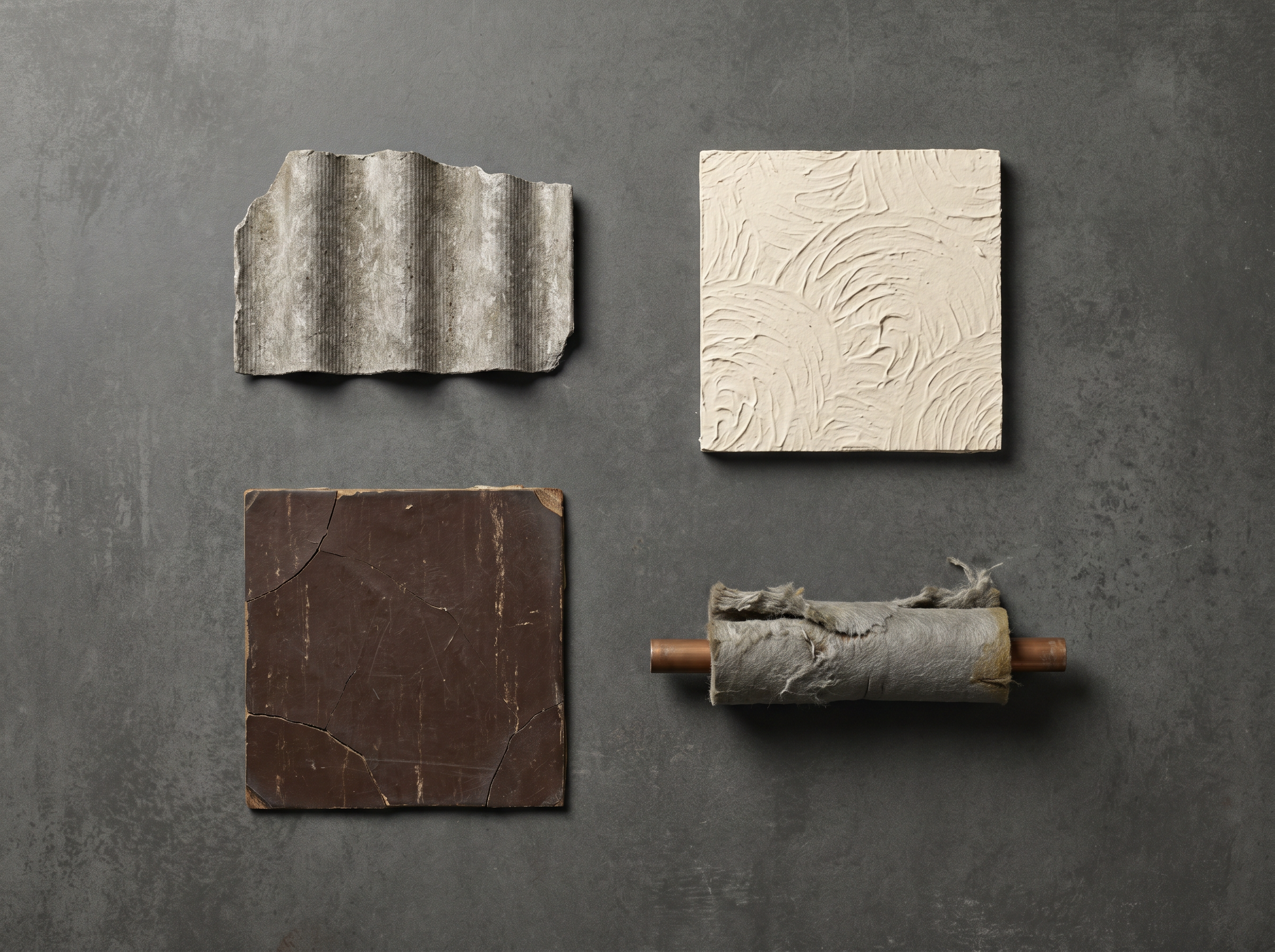
Four of the most common ACMs found in UK homes: corrugated cement sheet, textured Artex coating, vinyl floor tile, and pipe lagging. None can be confirmed as asbestos-containing by appearance alone.
Eight Materials to Know — and What They Look Like
The following table covers the eight most common asbestos-containing materials found in UK residential and commercial properties. Select any row to read the full identification notes for that material.
| Material | Risk | Visible? |
|---|---|---|
| Asbestos Cement Sheets | Low | Sometimes |
| Textured Decorative Coatings (Artex) | Medium | Rarely |
| Vinyl & Thermoplastic Floor Tiles | Low | Rarely |
| Asbestos Insulating Board (AIB) | High | Rarely |
| Pipe Lagging & Thermal Insulation | High | Rarely |
| Sprayed Asbestos Coatings | High | Sometimes |
| Soffit Boards & Fascia Panels | Low | Rarely |
| Loose-Fill Cavity Insulation | High | Rarely |
Click any row to expand identification notes.
Quick Risk Assessment: Should You Get It Tested?
Answer three questions to get an instant indication of whether the material you are looking at warrants professional testing. This is not a substitute for a formal survey — it is a starting point.
1. When was the building constructed or last substantially refurbished?
2. What type of material are you looking at?
3. What is the condition of the material?
The Most Common ACMs — A Closer Look
Asbestos Cement: The Most Widespread ACM in UK Gardens
Walk down any residential street in Surrey or South London and you will see it. The corrugated grey roof on a detached garage, the flat panels on a garden shed, the guttering on an outbuilding — asbestos cement is by far the most common ACM in UK residential properties. The HSE estimates that asbestos cement products account for approximately 85% of all asbestos used in UK construction (HSG264, 2nd edition, para 115).
Asbestos cement is a composite material — ordinary Portland cement mixed with chrysotile fibres, typically at a ratio of 10–15% asbestos by weight. The fibres are tightly bound within the cement matrix, which makes intact asbestos cement a relatively low-risk material. The risk increases significantly when sheets are broken, drilled, cut, or weathered to the point where the surface is friable.
Visually, asbestos cement has a hard, grey appearance. Corrugated sheets have a distinctive wave profile, typically with a pitch of 75 mm or 150 mm. Flat sheets are smooth or slightly textured. With age, the surface often develops a rough, pitted texture, and green algae or moss growth is common. The edges of broken sheets may show a layered internal structure.
Modern fibre-cement products (made with cellulose or glass fibre) are visually very similar. The only reliable way to distinguish them is laboratory analysis or the age of the installation.
Artex and Textured Coatings: The Hidden Ceiling Problem
Artex — and similar textured decorative coatings from manufacturers including Neocork, Wondertex, and Suretex — was applied to millions of UK ceilings between the 1960s and the late 1980s. Chrysotile was added to the dry mix to improve workability and reduce cracking. The finished coating is hard and brittle, with a characteristic swirled, stippled, or peaked surface texture.
The critical point about Artex is that the pattern gives you no information about asbestos content. The same stipple pattern was produced with and without asbestos depending on the manufacturer, the batch, and the date. A ceiling installed in 1972 and one installed in 1989 may look identical but have very different asbestos content.
Chrysotile content in Artex products ranged from approximately 3% to 5% by weight (Virta, R.L., 2006, USGS Minerals Yearbook). At these concentrations, intact Artex poses a low risk. The risk rises sharply when the coating is sanded, drilled, or scraped — activities that release fibres into the air at concentrations that can exceed the HSE's control limit of 0.1 fibres per millilitre of air (CAR 2012, Regulation 3).
If you are planning any work that involves disturbing a textured ceiling in a pre-1990 property — including fitting recessed lighting, installing a loft hatch, or simply redecorating — get it tested first.
Asbestos Insulating Board: The High-Risk Interior Material
Asbestos insulating board (AIB) was manufactured by companies including Cape Boards, Turners Asbestos, and Bell's Asbestos. It was used extensively from the 1950s to the mid-1980s as ceiling tiles, partition panels, fire-rated linings, and boiler cupboard cladding. Amosite (brown asbestos) content typically ranges from 20% to 45% by weight, with some products containing crocidolite.
AIB is lighter and softer than asbestos cement. It has a flat, smooth surface and is often painted. In ceiling tile form, it may have a regular grid pattern from the suspension system. In partition walls, it may be indistinguishable from plasterboard or non-asbestos insulating board.
The HSE classifies all work on AIB as licensable work under CAR 2012, Regulation 3(2). This means only a licensed contractor can remove, repair, or disturb AIB. The reason is straightforward — AIB is friable, and any disturbance releases amosite fibres at concentrations that can quickly exceed safe limits.
Pipe Lagging: The Most Dangerous Domestic ACM
Thermal insulation on pipes, boilers, and heating systems was one of the primary applications for amosite and crocidolite asbestos. In its intact state, pipe lagging is wrapped around pipework and covered in a protective coating — often canvas, hessian, or a plaster render. The underlying insulation material is fibrous, grey or buff in colour, and crumbles easily when disturbed.
Degraded pipe lagging — where the protective outer coating has failed and the insulation is exposed — is the most dangerous condition in which asbestos is typically found in domestic properties. Fibres shed continuously from degraded lagging without any disturbance. If you find crumbling, fibrous material around old pipework or a boiler in a pre-1985 property, treat it as a priority.
What Visual Inspection Can and Cannot Tell You
Visual inspection CAN indicate:
- Whether a material is consistent with a known ACM type
- The approximate age of a material based on style and installation method
- The condition of the material (intact, damaged, friable)
- The location and extent of suspect materials
- Whether disturbance has already occurred
Visual inspection CANNOT tell you:
- Whether a specific material contains asbestos
- Which type of asbestos is present
- The percentage of asbestos by weight
- Whether fibres are currently being released
- Whether the material is safe to disturb
How Asbestos Testing Actually Works
The standard analytical method for confirming asbestos in a building material is polarised light microscopy (PLM). A UKAS-accredited laboratory analyst examines a small bulk sample under a polarising microscope and identifies asbestos fibres by their optical properties — refractive index, birefringence, and extinction angle. This method can identify all six regulated asbestos types and estimate the percentage content.
Sampling is straightforward. A surveyor takes a small piece of the suspect material — typically a few square centimetres — seals it in a labelled container, and sends it to the laboratory under a chain of custody. Results are returned within 24–48 hours in most cases. The cost per sample is typically £30–£50 for laboratory analysis alone, or included as part of a professional survey.
For homeowners who want to know whether a specific material contains asbestos before planning renovation work, a targeted sampling visit from Pro Asbestos Removal covers the survey, sample collection, laboratory analysis, and a written report — all in a single visit.
How Pro Asbestos Removal Helps London and Surrey Households
If you have found a material you think might contain asbestos — whether it is a corrugated garage roof, a textured ceiling, old floor tiles, or crumbling pipe insulation — the next step is always the same: get it tested before you touch it.
Pro Asbestos Removal is a UKATA-certified, fully insured asbestos contractor covering Surrey, South London, and the wider South East. Our surveyors carry out professional sampling visits, arrange UKAS-accredited laboratory analysis, and provide a written report within 48 hours. If the material tests positive, we can proceed directly to licensed removal — no need to find a separate contractor.
Frequently Asked Questions
Sources & References
- [1] HSE. Asbestos: The Survey Guide (HSG264), 2nd edition. HMSO, 2012. Para 115–120 (asbestos cement identification).
- [2] HSE. Locations of asbestos and taking the right action. HSE.gov.uk, 2024.
- [3] Control of Asbestos Regulations 2012 (CAR 2012), SI 2012/632. Regulations 3, 4, 11.
- [4] Virta, R.L. Asbestos: Geology, Mineralogy, Mining, and Uses. USGS Open-File Report 02-149, 2002.
- [5] ATSDR. Toxicological Profile for Asbestos. Chapter 4: Chemical and Physical Information. CDC/ATSDR, 2001.
- [6] Oberta, A.F. Asbestos for Surveyors. RICS Books, 2018. Chapter 3 (visual identification methodology).
- [7] UKATA. Asbestos Gallery — Typical Examples of ACMs. UKATA.org.uk, 2024.
- [8] Millette, J.R. & Compton, S.T. Asbestos Analysis Methods. In: Asbestos Risk Assessment, Epidemiology, and Health Effects. Taylor & Francis, 2024.
Not Sure What You're Looking At?
Our surveyors cover Surrey, South London, and the South East. Same-week appointments available.
07345 062075Book Testing OnlineRelated Guides
Key Facts
Accidental Disturbance?
If you have already disturbed a suspect material, leave the area, close doors and windows, and call us immediately.
Emergency Line