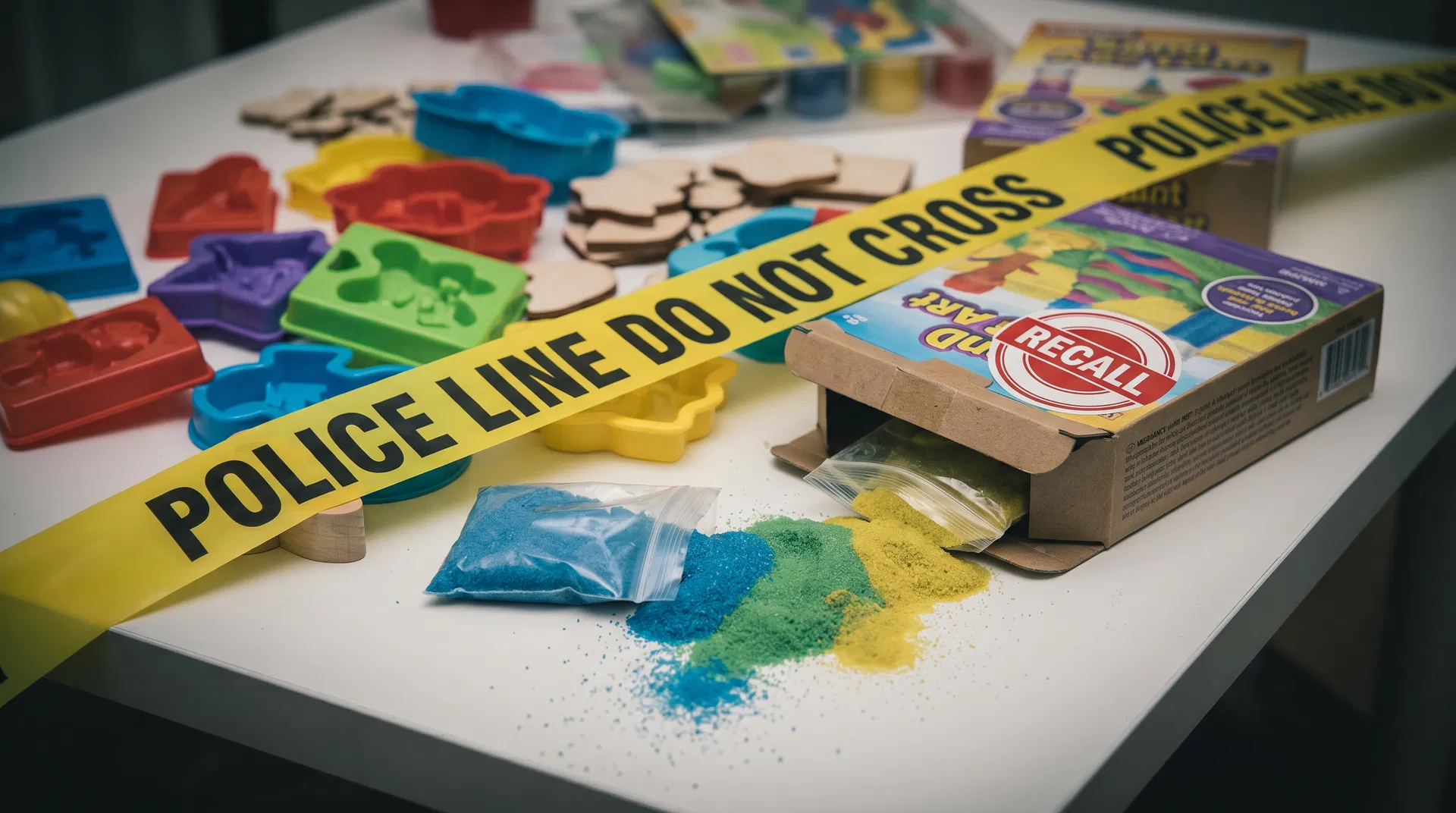
More than 30 children's toys have been recalled across the UK since January 2026 after laboratory testing confirmed asbestos contamination in the sand used to fill or decorate them. The products — ranging from coloured craft sand kits to stretchy rubber toys — were sold at major retailers including Hobbycraft, John Lewis, Tesco, Primark, Smyths Toys, Argos, Asda, Matalan, M&S, Aldi, and The Entertainer.
For most parents, the word "asbestos" conjures images of old industrial buildings or crumbling garage roofs — not a craft kit bought for a rainy afternoon. That's what makes this recall so unsettling. The contamination is invisible, odourless, and entirely undetectable without laboratory analysis. And the health consequences of asbestos exposure, while they take decades to manifest, are serious.
This article explains what happened, which products are affected, what the health risks actually are, and — critically — what you should do if you have one of these toys at home. We also explain how London and South East households can take a broader look at asbestos risk in their homes, because the toy recall is a sharp reminder that asbestos can appear in unexpected places.
How Did Asbestos End Up in Children's Toys?
The contamination traces back to sand sourced from mines in China. In certain geological formations, asbestos minerals — particularly tremolite and chrysotile — occur naturally alongside the silica and quartz deposits used to produce decorative and craft sand. Where mining and processing controls are less rigorous, asbestos fibres can contaminate the finished product without any visible sign of their presence.
The issue first surfaced in the UK in January 2026 when a customer alerted Hobbycraft to the presence of asbestos traces in the coloured sand bottles included in their Giant Box of Craft kit. Hobbycraft issued a national recall immediately, instructing customers to seal the contaminated bottles in double bags and seek council advice on disposal. The company subsequently recalled four further craft sets containing sand.
The Office for Product Safety and Standards (OPSS) then issued a formal product recall notice on 20 February 2026 for the Kids Create Sand Art Kit (barcode 5012128618222), manufactured by IG Design Group UK Limited and sold between January 2025 and February 2026. The kit contains three 20g bags of coloured sand and was stocked at John Lewis, Hobbycraft, Toy Master, and garden centres.
By March 2026, the OPSS had issued a technical advisory note for businesses and industry on testing for asbestos in consumer products containing sand. The recalls accelerated through April. Stretchy rubber toys — a popular category where sand is used as an internal filler to give the toys their characteristic weight and texture — emerged as a second category of concern. The HGL Stretchy Sand Monster Truck, HGL Stretchy Sand Pig, and Scrunchems Stretchies Sleepy Dino were all recalled by One For Fun Limited, whose chief executive David Mordecai announced the company had "discontinued the use of sand as a filler in all current and future products."
The problem is not unique to the UK. Australia's ACCC recalled children's sand products in November 2025 after tremolite and chrysotile were detected. US public health advocates urged the Consumer Product Safety Commission and EPA to act in April 2026. This is a global supply chain failure, not an isolated incident.
The Recalled Products: A Summary
The table below lists the key products recalled as of 28 April 2026. The full and continuously updated list is maintained on the OPSS Product Safety Alerts page on GOV.UK. More than 30 products have been recalled in total.
| Product | Retailer(s) | Recall Date | Contaminated Material |
|---|---|---|---|
| Hobbycraft Giant Box of Craft | Hobbycraft | January 2026 | Coloured craft sand |
| Hobbycraft Sand and Pom-Pom Art Kit | Hobbycraft | January 2026 | Coloured craft sand |
| Kids Create Sand Art Kit | John Lewis, Hobbycraft, Toy Master | 20 Feb 2026 | Three 20g bags coloured sand |
| Galt Nature Craft Kit | John Lewis, Hobbycraft | April 2026 | Yellow craft sand |
| HGL Stretchy Sand Monster Truck | Multiple UK retailers | April 2026 | Sand filler (internal) |
| HGL Stretchy Sand Pig | Multiple UK retailers | April 2026 | Sand filler (internal) |
| Scrunchems Stretchies Sleepy Dino | Multiple UK retailers | April 2026 | Sand filler (internal) |
| Texet Bright Start Fluorescent Craft Sand | Various | April 2026 | Fluorescent coloured sand |
| Addo Play Creative Candles Kit | Various | April 2026 | Decorative sand |
| KTL 2pc Balloon Dog Toy | Various | April 2026 | Sand filler (internal) |
| Stretcherz Toys (Kandy Toys range) | Various | Feb–Apr 2026 | Sand filler (internal) |
| Hobbycraft additional craft sets (×4) | Hobbycraft | Feb–Mar 2026 | Coloured craft sand |
Source: OPSS Product Safety Database, GOV.UK. Table reflects recalls confirmed as of 28 April 2026.
What Is Tremolite Asbestos — and Why Does It Matter?
Tremolite is an amphibole asbestos mineral. Its fibres are thin, needle-like, and extremely durable — properties that make them particularly hazardous when inhaled. Unlike the more commercially familiar chrysotile (white asbestos), which has curly, more easily cleared fibres, tremolite fibres penetrate deep into lung tissue and resist the body's natural clearance mechanisms.
Both tremolite and chrysotile are classified as Group 1 carcinogens by the International Agency for Research on Cancer (IARC). The UK banned the use, import, and supply of all asbestos types under the Control of Asbestos Regulations 2012 and its predecessors, with chrysotile banned in 1999. The presence of either type in a consumer product is therefore a legal violation as well as a health risk.
The primary disease associated with asbestos exposure is mesothelioma — a cancer of the pleural lining of the lungs. The UK has one of the highest mesothelioma rates in the world, with approximately 2,700 deaths recorded annually, a direct consequence of widespread industrial asbestos use in the twentieth century. Learn more about the health risks of asbestos exposure.
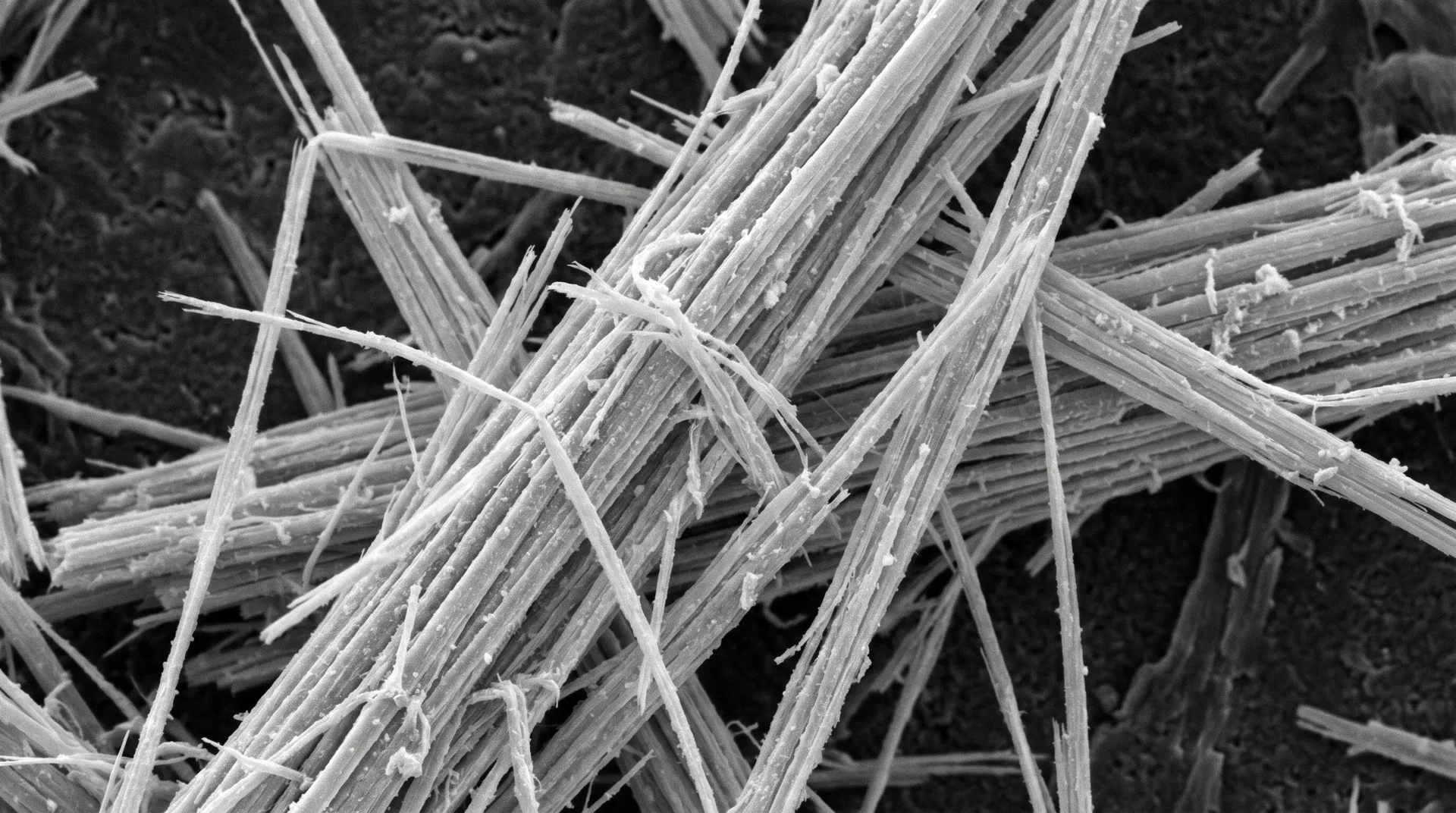
Tremolite asbestos fibres under electron microscopy — thin, needle-like, and highly persistent in lung tissue.
Is Childhood Exposure More Dangerous?
This is the question most parents are asking, and the honest answer is: yes, relatively speaking. A systematic review published in the International Journal of Environmental Research and Public Health (Kang et al., 2013) examined the relationship between age at first exposure and mesothelioma risk. Four of the studies reviewed found that people exposed to asbestos in childhood have a higher relative risk of mesothelioma than those first exposed in adulthood, when adjusted for total exposure duration.
The reason is the latency period. Mesothelioma typically develops 20 to 50 years after initial exposure. A child exposed at age five has a longer biological window for the disease to develop than an adult exposed at 40. That does not mean a single brief contact with a recalled toy will cause cancer — the dose-response relationship matters enormously, and a short, low-level exposure carries a very different risk profile from decades of occupational exposure. But the UK's regulatory position — that no safe threshold exists for asbestos exposure — reflects the scientific consensus that any exposure carries some measurable risk.
Minister for product safety Kate Dearden described the situation as "staggering" and confirmed that the government is introducing new measures to strengthen consumer protection and clamp down on irresponsible sellers. The OPSS has made asbestos-contaminated sand products a featured alert category on its recalls page — a designation reserved for products presenting a serious or high risk.
What to Do If You Have a Recalled Toy at Home
The OPSS has issued clear disposal guidance, and the steps differ depending on whether the sand has been used or remains sealed. Follow these instructions carefully — the key principle throughout is to avoid generating dust, because it is airborne fibres that pose the inhalation risk.
Stop Using the Product Immediately
Do not open any sealed sand bags. Do not allow children near the product. If the toy is a stretchy sand-filled item, do not squeeze or compress it further, as this can force sand particles through the outer membrane.
If the Sand Is Still Sealed
Place the entire product — packaging and all — into a heavy-duty plastic bag. Double-tape the bag securely. Label it clearly as 'asbestos-contaminated — do not open'. Store it in a secure location out of reach of children until you can return it to the retailer.
If the Sand Has Been Used
Put on disposable gloves and a dust mask before handling anything. Clean the area with wet cloths — never dry-sweep or vacuum, as this disperses fibres into the air. Double-bag the sand, gloves, mask, and cloths. Keep children and other people out of the area until cleaning is complete.
Return the Product for a Refund
Take the sealed double-bagged product back to the retailer for a full refund. If you cannot get to the store, dispose of the double-bagged material in your general household waste and contact the retailer by phone or email to arrange a refund. Retailers are legally obliged to provide one.
Check the OPSS Recalls Page
The list of recalled products is growing. Check the OPSS Product Safety Alerts page at gov.uk regularly and sign up for email alerts so you receive notification of new recalls as they are issued.
The Bigger Picture: Asbestos in London Homes
The toy recall has understandably alarmed parents, but it is worth placing it in a broader context. The contamination in these toys is a supply chain failure — asbestos introduced via imported sand. The more persistent and widespread source of asbestos exposure in UK households is the fabric of the buildings themselves.
Any property built before 2000 may contain asbestos-containing materials (ACMs). In London and the surrounding Home Counties, where Victorian, Edwardian, and post-war housing stock is abundant, the presence of ACMs is extremely common. Asbestos cement garage roofs, Artex textured ceilings, vinyl floor tiles, pipe lagging, and insulation boards were all standard building materials from the 1950s through to the late 1990s.
Undisturbed ACMs in good condition do not release fibres and do not present an immediate risk. The danger arises when they are drilled, sanded, cut, or disturbed during renovation work — activities that are extremely common in older properties. If you are planning any building work, an asbestos survey before work begins is not just good practice; it is a legal requirement under the Construction (Design and Management) Regulations 2015 for most commercial and domestic projects.
A plain-English explanation of what asbestos is, where it was used, and why it was banned.
Chrysotile, amosite, crocidolite, tremolite — what each type looks like and where it was used.
How to identify Artex that may contain asbestos and what your options are.
Step-by-step guidance if you discover or suspect asbestos in your home.
The toy recall has prompted many London households to ask whether their homes are safe. That is a reasonable question — and one that has a straightforward answer. A professional asbestos management survey will identify every accessible ACM in your property, assess its condition and risk level, and provide a written register. That register then forms the basis of an asbestos management plan — a document that tells you what to monitor, what to leave alone, and what to remove.
How Pro Asbestos Removal Helps London Households Stay Safe
Pro Asbestos Removal is a UKATA-certified, HSE-licensed asbestos removal contractor serving London, Surrey, and the South East. The team carries out every type of asbestos work a household might need — from a simple management survey to full licensed removal of garage roofs, Artex ceilings, floor tiles, pipe lagging, and insulation boards.
The toy recall is a reminder that asbestos can appear in unexpected places. But for most London households, the greater and more manageable risk is in the building itself. Here is what the team can do for you:
Identifies and risk-assesses all accessible ACMs in your property. Written register delivered within 48 hours. Required before any renovation work.
Bulk sample analysis by an accredited UKAS laboratory. Results within 24–48 hours. Confirms whether a material contains asbestos before you disturb it.
Full removal of licensed and non-licensed ACMs — garage roofs, Artex, floor tiles, pipe lagging, insulation boards. Air clearance certificate issued on completion.
A written plan that tells you how to manage ACMs in your property over time — what to monitor, what to leave, and when to act.
The team covers all London boroughs, Surrey, Kent, and Sussex. Same-week appointments are available, and all disposal paperwork — consignment notes, air clearance certificates, waste transfer documentation — is provided as standard. No hidden costs. No subcontracting.
A Supply Chain Problem With No Quick Fix
The scale of this recall — 30+ products across a dozen retailers — reflects a systemic failure in the supply chain for decorative and craft sand. The OPSS technical advisory note issued in March 2026 acknowledged that the problem extends beyond individual products and called on businesses across the sector to test their sand-containing products proactively.
The root cause is geological. Certain sand deposits in China — particularly in regions supplying coloured craft sand and sand used as toy filler — lie in geological formations where tremolite and chrysotile occur naturally. Without rigorous testing at the point of extraction and processing, contaminated sand enters the supply chain and ends up in products that are then exported globally.
Australia's ACCC identified the same problem in November 2025. The International Ban Asbestos Secretariat has documented the issue across multiple product categories. The UK's response — mandatory recall and the OPSS advisory note — is appropriate, but the pace of recalls suggests that testing was not routine practice across the industry before this crisis emerged.
For consumers, the practical implication is straightforward: check the OPSS recalls page before purchasing any sand-based craft product, and check it again if you already own one. The list is being updated as new products are tested and confirmed to be contaminated.
Further Reading
Frequently Asked Questions
Sources & References
- Office for Product Safety and Standards (OPSS). Product Recall: Kids Create Sand Art Kit (2602-0206). GOV.UK, 20 February 2026.
- OPSS. Product Safety Alerts, Reports and Recalls — Featured Alerts. GOV.UK, updated 21 April 2026.
- PA Media / Yahoo Finance. More than 30 toys recalled for asbestos since start of year. 27 April 2026.
- Kang D, et al. Systematic Review of the Effects of Asbestos Exposure on the Risk of Cancer between Children and Adults. Int J Environ Res Public Health. 2013;10(6):2659–2671. PMC3923347.
- IARC. Asbestos (chrysotile, amosite, crocidolite, tremolite, actinolite, and anthophyllite). IARC Monographs Vol. 100C, 2012.
- Australian Competition and Consumer Commission (ACCC). Customers warned of recalled children's sand due to asbestos risks. 12 November 2025.
- SGS. Australia Recalls Play Sand Containing Asbestos. 18 February 2026.
- Health and Safety Executive (HSE). Control of Asbestos Regulations 2012. SI 2012/632.