The Six Types at a Glance
Asbestos is not a single mineral. It is a commercial and regulatory term applied to six naturally occurring silicate minerals that share a fibrous crystal structure. The IARC classified all six as Group 1 carcinogens in its 2012 Monograph — meaning there is sufficient evidence that each type causes cancer in humans.[1] Three were used extensively in UK construction; three were used in smaller quantities, primarily as contaminants in other materials.
| Common Name | Mineral Name | Group | UK Ban | UK Use | Mesothelioma Risk |
|---|---|---|---|---|---|
| White asbestos | Chrysotile | Serpentine | 1999 | Very widespread | High |
| Brown asbestos | Amosite | Amphibole | 1985 | Widespread | Very High |
| Blue asbestos | Crocidolite | Amphibole | 1985 | Moderate | Highest |
| — | Tremolite | Amphibole | 1999 | Contaminant | High |
| — | Anthophyllite | Amphibole | 1999 | Rare | High |
| — | Actinolite | Amphibole | 1999 | Rare | High |
Serpentine vs Amphibole: Why Fibre Structure Determines Risk
The six asbestos types divide into two mineralogical groups based on crystal structure, and this structural difference is the primary reason why the types carry different health risk profiles.
Serpentine (Chrysotile only)
Chrysotile fibres are curly and flexible — a layered silicate structure that causes the fibres to coil into a helical shape. This curvature means the fibres are more likely to be trapped in the upper airways and cleared by mucociliary action. Half-life in lung tissue: approximately 11 days.[2] Despite this, chrysotile still causes mesothelioma, lung cancer, and asbestosis at sufficient doses.
Amphibole (Amosite, Crocidolite & others)
Amphibole fibres are straight, rigid, and needle-like — a double-chain silicate structure that allows them to penetrate deep into the lung parenchyma and pleura. The body cannot clear them effectively. Crocidolite fibres have a half-life in lung tissue measured in decades.[2] This biopersistence is the primary reason amphibole types carry a substantially higher mesothelioma risk per fibre than chrysotile.
The practical implication for UK homeowners is straightforward: pipe lagging, insulation boards, and spray coatings — which are more likely to contain amosite or crocidolite — require more urgent professional assessment than asbestos cement sheets, which almost always contain chrysotile. That said, no type of asbestos is safe to disturb without professional assessment.
Chrysotile — White Asbestos
Chrysotile accounts for approximately 95% of all asbestos ever used commercially worldwide.[3] In the UK, it was the dominant type in construction from the 1950s through to its ban in 1999. The name derives from the Greek chrysos (gold) and tilos (fibre) — a reference to the silky, golden-white appearance of the raw mineral.
Under a scanning electron microscope, chrysotile fibres appear as tightly coiled, rope-like bundles. This serpentine structure is unique among the six types. The fibres are flexible enough to be woven into textiles — chrysotile was used in fireproof theatre curtains, brake linings, and protective clothing, as well as in the cement products and textured coatings that are most commonly found in UK homes today.
The IARC's 2012 Monograph confirmed that chrysotile causes mesothelioma, lung cancer, laryngeal cancer, and ovarian cancer.[1] The relative risk per fibre is lower than for amphibole types, but the sheer volume of chrysotile used in UK buildings means it accounts for the majority of asbestos-related disease cases in this country.
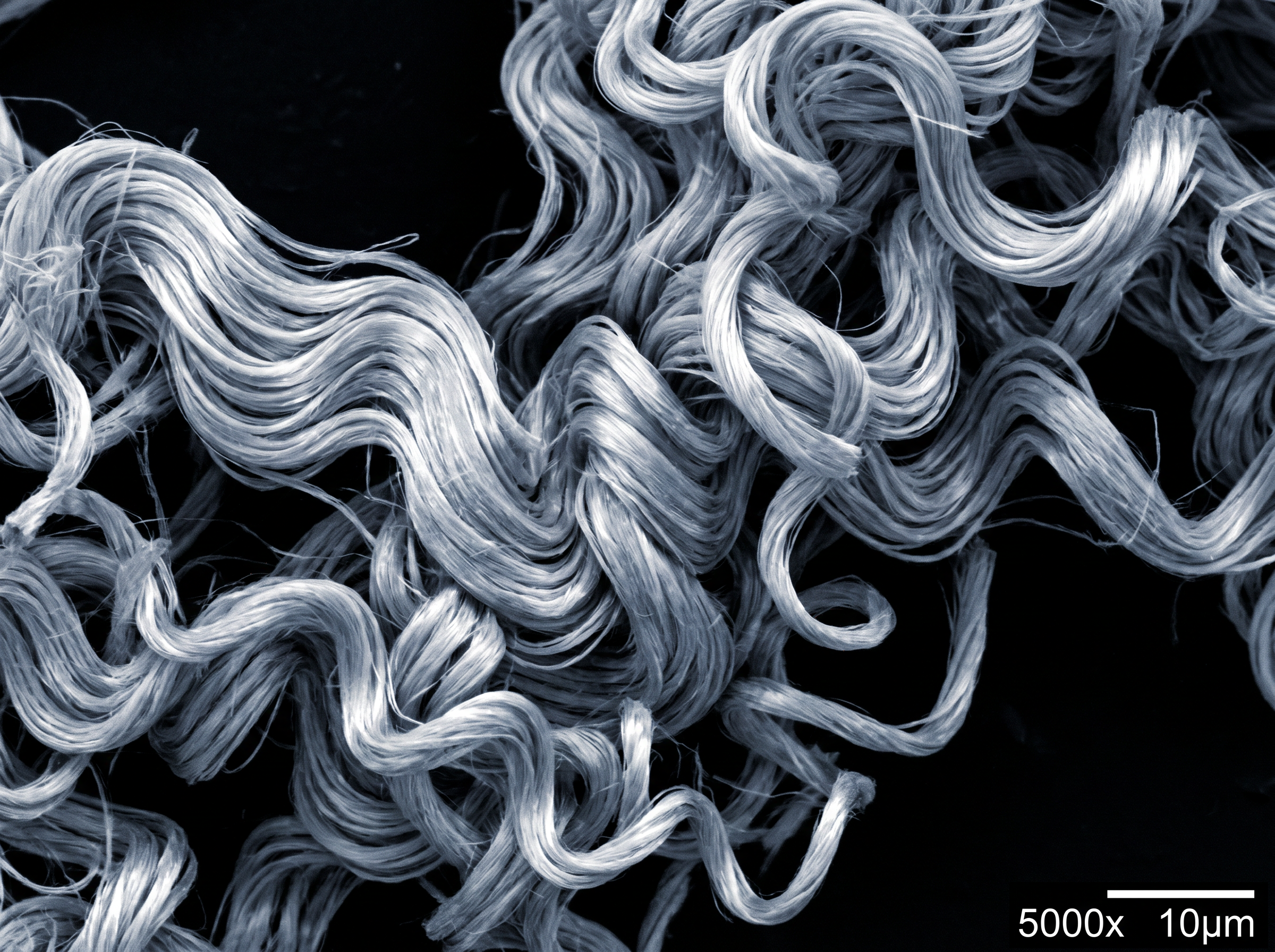
Chrysotile fibres at 5000× magnification — curly, flexible serpentine structure
Where chrysotile is found in UK properties
Amosite — Brown Asbestos
Amosite takes its name from the acronym AMOSA — Asbestos Mines of South Africa — where it was primarily extracted. It is an amphibole asbestos of the grunerite mineral group, with straight, brittle fibres that are typically 3–5 micrometres in diameter. These fibres are significantly more biopersistent than chrysotile, with a half-life in lung tissue measured in years rather than days.[2]
In the UK, amosite was the second most widely used asbestos type. Its primary applications were thermal and acoustic insulation — spray-applied to structural steelwork as fire protection, pressed into insulation boards (Asbestolux, Marinite, Limpet), and used in ceiling tiles and partition systems. It was also used in pipe lagging for heating and hot water systems in commercial and industrial buildings.
Amosite carries a mesothelioma risk per fibre that is approximately 100 times higher than chrysotile, according to the analysis by Hodgson and Darnton (2000).[4] In domestic properties, amosite is most likely to be found in ceiling tiles, partition boards, and the insulation of pre-1980 heating systems.
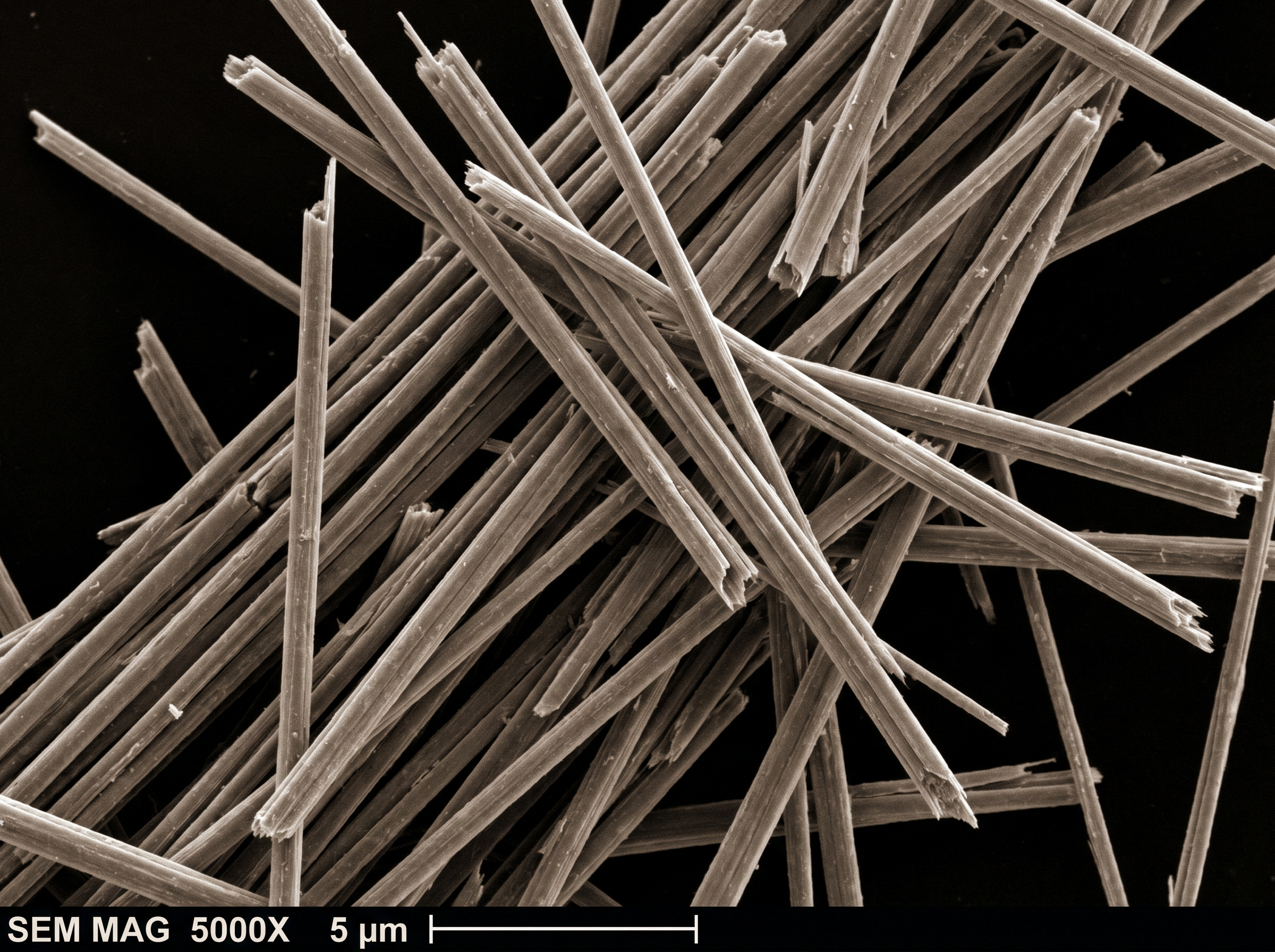
Amosite fibres at 5000× magnification — straight, rigid amphibole rods
Where amosite is found in UK properties
Ceiling tiles and suspended ceiling systems; insulation boards (Asbestolux, Marinite, Cape Insulation Board); fire doors and partition walls; pipe lagging on heating and hot water systems; spray-applied fire protection on structural steelwork in commercial buildings constructed between 1950 and 1985.
Crocidolite — Blue Asbestos
Crocidolite is the most hazardous of all six asbestos types. Its fibres are the thinnest of any asbestos mineral — typically 0.1–0.3 micrometres in diameter — and their straight, needle-like form allows them to penetrate the deepest regions of the lung and the pleural lining. Once lodged, they remain there for decades, causing chronic inflammation that drives the development of mesothelioma.
The mesothelioma risk per fibre for crocidolite is approximately 500 times higher than for chrysotile.[4] Even brief, low-level exposure carries a meaningful risk. The UK recognised this earlier than for other types: crocidolite was banned in 1985, fourteen years before the full asbestos ban.
In UK buildings, crocidolite was used in spray insulation, pipe lagging, and some insulation boards. It is less common in domestic properties than in commercial and industrial buildings constructed between 1950 and 1985. If a survey identifies crocidolite, it should be treated as a priority for professional removal.
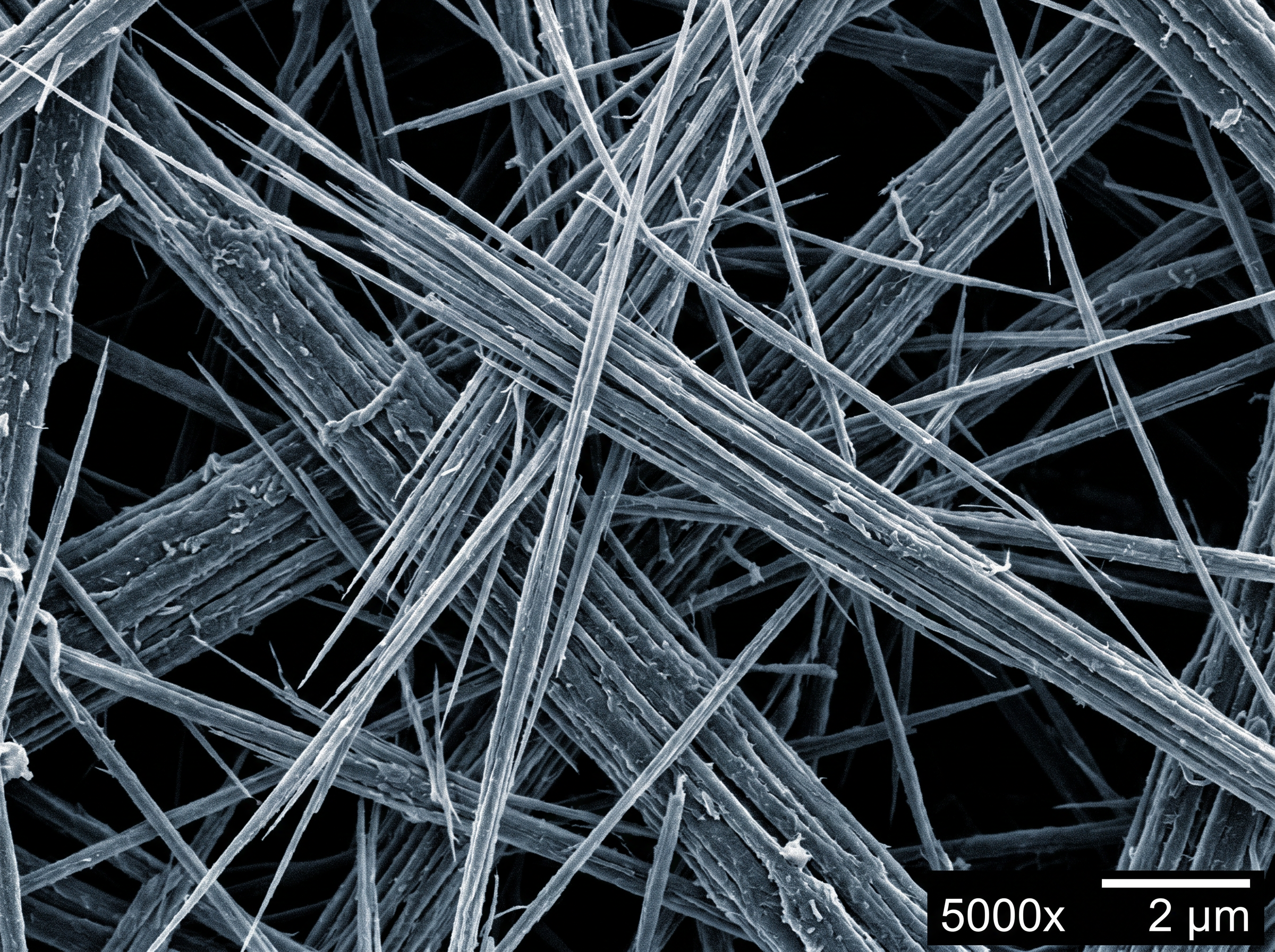
Crocidolite fibres at 5000× magnification — ultra-fine, needle-like amphibole structure
Highest-risk material — professional assessment required immediately
If a survey identifies crocidolite in your property, do not disturb the material under any circumstances. Contact a licensed asbestos removal contractor. Crocidolite removal requires a licensed contractor under the Control of Asbestos Regulations 2012.
Tremolite, Anthophyllite, and Actinolite
The three remaining asbestos types — tremolite, anthophyllite, and actinolite — were not used as primary construction materials in the UK. Their significance lies in the fact that they occur as contaminants in other minerals and products. Tremolite, in particular, has been found as a contaminant in chrysotile deposits, vermiculite insulation, and talc-based products. The toy asbestos recall of 2026 involved tremolite contamination in Chinese play sand.[5]
Tremolite
Ca₂Mg₅Si₈O₂₂(OH)₂
Implicated in the 2026 UK toy recall
Anthophyllite
Mg₇Si₈O₂₂(OH)₂
Limited commercial use globally
Actinolite
Ca₂(Mg,Fe)₅Si₈O₂₂(OH)₂
All three are IARC Group 1 carcinogens
All three are amphibole asbestos types and carry the same biopersistence characteristics as amosite and crocidolite. The IARC's classification applies equally to all six types. For UK homeowners, the practical relevance of these three types is primarily through contamination — if you have vermiculite insulation in your loft, for example, it may contain tremolite or actinolite and should be assessed before any disturbance.
UK Usage History and Ban Timeline
The UK was one of the world's largest consumers of asbestos during the twentieth century. Peak consumption occurred in the 1960s and 1970s, when asbestos was used in virtually every type of construction — from domestic garages to power stations, schools, hospitals, and office blocks. The USGS estimates that global asbestos production peaked at approximately 5 million tonnes per year in the late 1970s, with the UK importing hundreds of thousands of tonnes annually during this period.[6]
Peak use of all three main types in UK construction. Chrysotile in cement products; amosite in insulation boards and fire protection; crocidolite in spray insulation and pipe lagging.
Asbestos Regulations introduced — first UK legislation requiring dust control in asbestos processing. Did not restrict use in buildings.
Asbestos (Prohibitions) Regulations ban the import, supply, and use of crocidolite (blue) and amosite (brown) asbestos in the UK.
Control of Asbestos at Work Regulations tightened. Duty to manage asbestos in non-domestic premises introduced.
Full UK ban on chrysotile (white asbestos) under the Asbestos (Prohibitions) (Amendment) Regulations. All six types now prohibited.
Control of Asbestos at Work Regulations 2002 introduced the formal duty to manage asbestos in non-domestic premises.
Control of Asbestos Regulations 2012 (CAR 2012) consolidate all previous asbestos regulations. Still the primary legislation governing asbestos management in the UK.
Health Risk Comparison
All six asbestos types cause the same four diseases: mesothelioma, lung cancer, asbestosis, and diffuse pleural thickening. The difference between types is not which diseases they cause, but the dose required to cause them. Amphibole types — particularly crocidolite — cause mesothelioma at lower cumulative fibre doses than chrysotile, because their biopersistence in lung tissue is far greater.
| Type | Mesothelioma risk / fibre | Lung half-life | Latency period | Diseases caused |
|---|---|---|---|---|
| Chrysotile | 1× (reference) | ~11 days | 20–60 years | Mesothelioma, lung cancer, asbestosis, pleural thickening |
| Amosite | ~100× | Years | 20–50 years | Mesothelioma, lung cancer, asbestosis, pleural thickening |
| Crocidolite | ~500× | Decades | 20–50 years | Mesothelioma, lung cancer, asbestosis, pleural thickening |
| Tremolite | High (amphibole) | Decades | 20–50 years | Mesothelioma, lung cancer |
| Anthophyllite | High (amphibole) | Decades | 20–50 years | Mesothelioma, lung cancer |
| Actinolite | High (amphibole) | Decades | 20–50 years | Mesothelioma, lung cancer |
Relative risk ratios based on Hodgson & Darnton (2000), Annals of Occupational Hygiene.[4] Lung half-life data from Bernstein et al. (2005).[2]
UK asbestos-related disease statistics (HSE, 2024)
Common Asbestos-Containing Products in UK Buildings
The table below lists the most common asbestos-containing materials (ACMs) found in UK domestic and commercial properties, with the asbestos type typically present and the risk level when the material is in good condition. Condition matters: a well-bonded, undamaged asbestos cement sheet presents a much lower risk than friable pipe lagging in poor condition.
| Product / Material | Asbestos type | Typical location | Risk (undisturbed) |
|---|---|---|---|
| Corrugated asbestos cement sheets | Chrysotile | Garage roofs, shed cladding, outbuildings | Low–Medium |
| Textured coatings (Artex) | Chrysotile | Ceilings and walls (applied pre-2000) | Low |
| Vinyl floor tiles + adhesive | Chrysotile | Kitchens, hallways, bathrooms | Low |
| Asbestos insulation board (AIB) | Amosite / Chrysotile | Ceiling tiles, partition walls, fire doors | Medium–High |
| Pipe lagging / thermal insulation | Amosite / Crocidolite | Heating systems, hot water pipes, boiler rooms | High (if friable) |
| Spray-applied fire protection | Amosite / Crocidolite | Structural steelwork in commercial buildings | High (if friable) |
| Asbestos rope and gaskets | Chrysotile | Boilers, furnaces, heating appliances | Medium |
| Asbestos cement flue pipes | Chrysotile | Boiler flues, utility rooms, roof spaces | Medium |
| Vermiculite insulation (loft) | Tremolite (contaminant) | Loft spaces (Zonolite brand, pre-1990) | Medium–High |
| Asbestos cement guttering | Chrysotile | External gutters and downpipes | Low |
What to Do If You Suspect Asbestos in Your Property
You cannot identify the type of asbestos in a building material by looking at it. The only reliable method is laboratory analysis of a sample taken by a trained professional. If you suspect asbestos in your property — particularly if you are planning any renovation, demolition, or repair work — the correct sequence is straightforward.
Do not disturb the material
If you suspect a material contains asbestos, leave it alone. Do not drill, sand, cut, or break it. The risk from undisturbed asbestos in good condition is low; the risk from disturbing it without protection is significant.
Book a management survey
A UKATA-accredited asbestos management survey will identify all asbestos-containing materials in your property, assess their condition, and produce a written register. This is the foundation of any asbestos management plan.
Review the survey report
The report will identify the type of asbestos present, its condition, and a risk score. Materials in good condition may be managed in place; damaged or friable materials will require encapsulation or removal.
Act on the recommendations
If removal is recommended, instruct a licensed contractor. Crocidolite, amosite, and AIB removal all require a licensed contractor under CAR 2012. Chrysotile in good condition may be managed in place with a written management plan.
Maintain an asbestos register
Keep a written record of all asbestos-containing materials in your property, their location, condition, and any actions taken. Update it after any work that affects those materials.
Peer-Reviewed Citations
- [1] IARC Working Group (2012). Asbestos (Chrysotile, Amosite, Crocidolite, Tremolite, Actinolite, and Anthophyllite). IARC Monographs on the Evaluation of Carcinogenic Risks to Humans, Vol. 100C. Lyon: IARC. PubMed Bookshelf
- [2] Bernstein DM et al. (2005). "Health risk of chrysotile revisited." Critical Reviews in Toxicology, 43(2), 154–183. doi:10.3109/10408444.2012.756454
- [3] USGS Mineral Resources Program (2023). Asbestos Statistics and Information. United States Geological Survey. usgs.gov
- [4] Hodgson JT, Darnton A (2000). "The quantitative risks of mesothelioma and lung cancer in relation to asbestos exposure." Annals of Occupational Hygiene, 44(8), 565–601. doi:10.1016/S0003-4878(00)00045-4
- [5] OPSS (2026). Product Recall: Asbestos-contaminated play sand in children's toys. Office for Product Safety and Standards, GOV.UK. gov.uk
- [6] Ross M, Nolan RP (2003). "History of asbestos discovery and use." Geological Society of America Special Papers, 373, 447–470. doi:10.1130/0-8137-2373-6.447
- [7] HSE (2024). Asbestos-related disease statistics, Great Britain, 2024. Health and Safety Executive. hse.gov.uk
- [8] UKHSA (2024). Asbestos: toxicological overview. UK Health Security Agency. gov.uk