Asbestos Garage Roof Removal in Croydon, Surrey, London & South East
A cracked or weathered asbestos garage roof is one of the most common asbestos hazards found on UK residential properties. When the corrugated cement panels begin to degrade, they shed fibres with every rainfall and gust of wind. We remove the panels safely and, if required, re-roof the garage in the same visit.
The Risk You Can't See
Asbestos cement garage roofs were installed on millions of UK properties between the 1950s and mid-1980s. In their bonded state, the fibres are locked into the cement matrix and present a low risk. The problem begins when the surface starts to erode.
UV radiation, frost, and biological growth — moss, lichen, algae — all accelerate the breakdown of the cement binder. Once the surface becomes chalky and porous, fibres begin to protrude and are released by rain, wind, and physical contact. Pressure washing an asbestos roof, which many homeowners attempt to clean them, can release fibre concentrations many times above the HSE's control limit of 0.1 f/cm³.
The enclosed nature of a garage means fibres that enter through the roof accumulate inside rather than dispersing. Anyone retrieving tools, working on a vehicle, or simply walking past the garage regularly is exposed to a cumulative fibre burden over years.
Signs You Need to Act Now
- Roof panels are bowing, cracking, or showing surface erosion
- Chalky white or grey residue on surfaces beneath the roof
- Moss or lichen covering more than 20% of the roof surface
- Panels have been drilled, cut, or damaged by previous work
- You are planning to sell, extend, or demolish the property
- The garage was built before 1990
How Asbestos Cement Roof Panels Degrade
Corrugated asbestos cement sheets — sometimes called Eternit or AC sheets — are made from Portland cement reinforced with chrysotile fibres. New panels are hard and dense, with fibres fully encapsulated. Over time, the cement carbonates and the surface becomes progressively more friable.
The degradation process accelerates significantly after 30 to 40 years. Freeze-thaw cycles cause micro-cracking. Biological growth penetrates the surface and physically disrupts the cement matrix. The result is a surface that releases fibres on contact — and, in wet weather, releases them passively as water runs off the roof.
Roof panels deteriorate faster than the walls in almost every case. The roof receives the most UV, the most rainfall, and the most temperature cycling. A garage with intact-looking walls can have a roof that is already in a notifiable condition under CAR 2012.
Asbestos-related disease kills approximately 5,000 people in the UK every year — more than road traffic accidents. The HSE's control limit for chrysotile is 0.1 fibres per cubic centimetre, a level that degraded asbestos cement can exceed during routine disturbance.
Source: Health and Safety Executive (HSE), EH10 — Asbestos: The analysts' guide, 2023
Corrugated Roof Sheets
Primary Hazard
The main roof covering on the majority of pre-2000 garages. Corrugated profile sheds water but concentrates UV damage on the ridges.
Ridge Tiles
Often Asbestos Cement
The ridge capping at the apex of the roof is frequently asbestos cement. It is often overlooked in partial removal jobs, leaving a residual hazard.
Guttering & Downpipes
Secondary Locations
Asbestos cement guttering and downpipes were standard on garages built before 1985. They are fragile and release fibres when disturbed during roof work.
A Complete, Compliant Service
Get Your Free Quote Today
No obligation. We'll assess your job, explain the process, and give you a clear written quote — usually within 24 hours.
Roof Removal Only or Full Garage Demolition?
The right scope depends on the condition of the walls and your plans for the site.
Roof Panels Only
When the garage structure is sound and the walls are asbestos-free, removing just the roof and re-roofing is the most cost-effective solution.
- Lower cost than full demolition
- Garage structure retained and usable
- Re-roofing in GRP, metal, or polycarbonate
- Completed in a single visit
Full Garage Demolition
When the walls also contain asbestos cement, or when the structure is beyond repair, full demolition removes all hazardous material in one visit.
- All asbestos-containing materials removed
- Site left clear and level
- Single disposal certificate covers everything
- Recommended for pre-1985 garages with AC walls
How We Work
Free Site Survey
We assess the roof condition, confirm asbestos content, and provide a written quote — usually within 24 hours.
Preparation
The area is cordoned off and signage erected. Full PPE including P3 respirators donned before work begins.
Panel Removal
Sheets are scored, wetted, and removed intact where possible. Ridge tiles, guttering, and downpipes removed in the same operation.
Bagging & Disposal
All material is double-bagged, labelled, and transported directly to a licensed disposal facility.
Re-Roofing
New roof covering fitted in the same visit. GRP fibreglass is the most popular for longevity and low maintenance.
When You Need to Act
Panels are cracking or bowing
Act NowCracked panels release fibres continuously. Rainfall accelerates the release. Every week of delay increases cumulative exposure.
You plan to sell the property
This MonthSurveyors flag asbestos roofs in homebuyer reports. Removal before listing avoids price reductions and delays at exchange.
You plan to pressure-wash the roof
Act NowPressure washing an asbestos roof releases fibre concentrations far above the HSE control limit. Do not proceed without licensed removal.
Roof is intact but over 35 years old
Plan AheadPanels that look sound externally may be internally degraded. A survey now establishes condition and avoids emergency removal costs later.
The Most Expensive Mistake We See
The most expensive mistake we see is fitting a new roof over the existing asbestos panels — known as over-cladding. This is not a compliant solution. The asbestos remains in situ, the duty holder obligation persists, and when the property is sold or demolished the removal cost is higher because the new cladding must be stripped first. Licensed removal and re-roofing in a single visit costs less in the long run.
Our Approach to Roof Removal
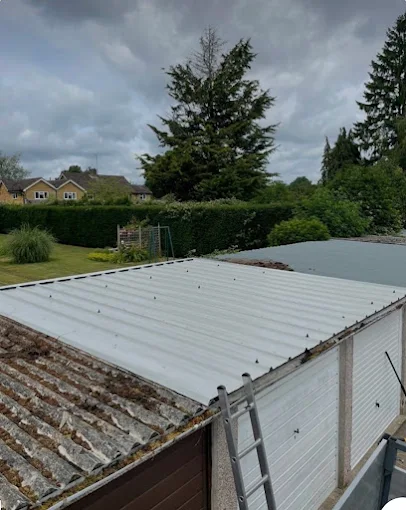
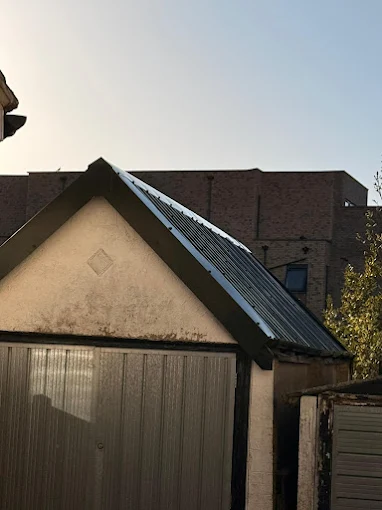
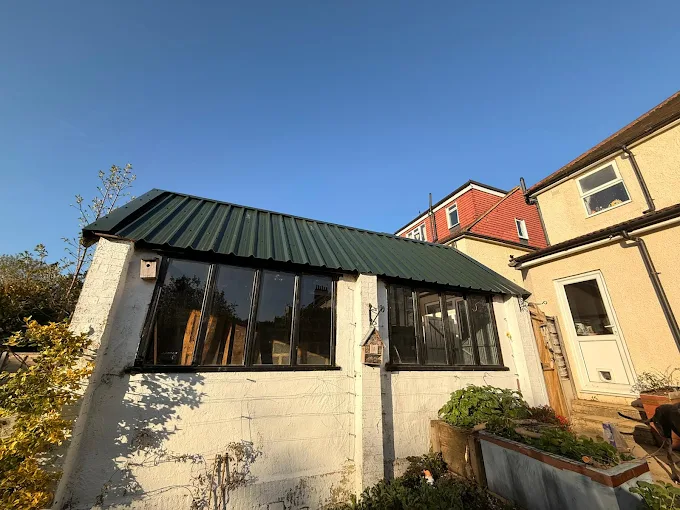
We assess the roof condition before quoting, not after. If the panels are in a notifiable condition, we confirm this in writing so you understand exactly what you are paying for and why. On the day, sheets are removed intact wherever possible — scored and wetted to suppress fibre release — and lowered to ground level without breakage. Re-roofing is carried out in the same visit using GRP fibreglass, corrugated metal, or polycarbonate sheeting. You receive a waste transfer certificate and consignment note on completion.
HSE Licensed
Current HSE licence for notifiable asbestos work, verifiable on the HSE public register.
Re-Roofing Included
GRP, corrugated metal, or polycarbonate re-roofing completed in the same visit — no second contractor needed.
Full Paperwork
Consignment note, waste transfer certificate, and completion letter for solicitors and building control.
From Our Recent Work
Common Questions
Can I just paint over an asbestos garage roof?
Encapsulation paint can temporarily stabilise a lightly degraded surface, but it is not a permanent solution and does not remove the duty holder obligation. It is not suitable for panels that are already cracking or bowing. Licensed removal is the only permanent resolution.
How do I know if my garage roof is asbestos cement?
Any corrugated grey or white cement roof on a garage built before 2000 is likely to be asbestos cement. The only way to confirm is laboratory analysis of a sample. We can take samples as part of a free site visit.
Can you re-roof the garage on the same day?
Yes. We carry re-roofing materials on the van and complete the new roof in the same visit in the majority of cases. The garage is weathertight before we leave.
What re-roofing materials do you offer?
We offer GRP fibreglass (the most durable option, 25-year lifespan), corrugated steel or aluminium, and polycarbonate sheeting. We will advise on the best option for your garage during the site visit.
Further Reading
What Is Asbestos?
Types, risks, and where it is found in UK homes and garages.
Asbestos Removal Cost Guide
Typical price ranges for roof removal across Surrey and London.
Do I Need an Asbestos Survey?
When a survey is legally required before removal work begins.
Asbestos Regulations UK
CAR 2012, HSE licensing, and duty holder obligations.
Ready to Get This Sorted?
We cover Surrey, London, and the South East. Call us or request a free quote online — we'll get back to you the same day.
Pro Asbestos Removal · Surrey, London & South East · Mon–Sat 7am–6pm
Areas We Cover
- Croydon — We offer asbestos removal services in Croydon
- Surrey — We offer asbestos removal services across Surrey
- Guildford — We offer asbestos removal services in Guildford
- South London — We offer asbestos removal services across South London
- London — We offer asbestos removal services across London
- Woking — We offer asbestos removal services in Woking
- Banstead — We offer asbestos removal services in Banstead
- Sutton — We offer asbestos removal services in Sutton
- Bromley — We offer asbestos removal services in Bromley
- Epsom — We offer asbestos removal services in Epsom
- Reigate — We offer asbestos removal services in Reigate
- Redhill — We offer asbestos removal services in Redhill