Asbestos in Artex: Is Your Textured Ceiling Safe?
Artex is one of the most common asbestos-containing materials in UK homes. Millions of ceilings applied before 1985 contain chrysotile fibres — and most homeowners have no idea.
What Is Artex, and Why Does It Contain Asbestos?
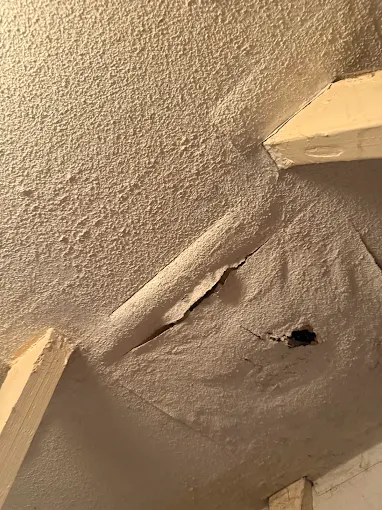
Artex is a brand name that became a generic term for textured decorative coatings applied to ceilings and walls. It was enormously popular in UK homes from the 1960s through to the 1990s — the swirled, stippled, and patterned finishes it produced were fashionable and practical, hiding imperfections in plasterwork. The original Artex formula, and many equivalent products from other manufacturers, contained chrysotile (white asbestos) as a reinforcing agent.
The asbestos content in textured coatings is typically low — between 1% and 5% by weight — but this does not mean it is safe to disturb. Chrysotile fibres in Artex are fine and easily airborne. When the coating is sanded, scraped, or abraded, those fibres become respirable. The Health and Safety Executive's Workplace Exposure Limit (WEL) for all asbestos types is 0.1 fibres per cubic centimetre (f/cm³), averaged over a four-hour period. Dry sanding Artex can produce concentrations many times this limit within seconds.
Do Not Sand Artex in a Pre-1993 Property
Dry sanding asbestos-containing Artex is classified as licensable work under the Control of Asbestos Regulations 2012 (CAR 2012). It produces the highest fibre concentrations of any domestic asbestos activity. Many homeowners and decorators have unknowingly sanded Artex ceilings, creating a contamination event that requires professional decontamination to resolve. If your property was built or decorated before 1993 and the original ceiling coating is still in place, treat it as potentially containing asbestos until tested.
Does Your Artex Contain Asbestos? The Period Guide
The installation date is the most reliable indicator. Artex applied before 1985 almost certainly contains asbestos. Between 1985 and 1993, the picture is mixed — some products had already transitioned away from asbestos, others had not. The only way to be certain is laboratory analysis.
| Installation Period | Likelihood of Asbestos |
|---|---|
| Pre-1985 | High |
| 1985–1993 | Moderate |
| Post-1993 | Very Low |
| Post-1999 | None |
How to Test Artex for Asbestos
Testing Artex requires taking a small sample and submitting it to a UKAS-accredited laboratory for analysis by polarised light microscopy (PLM). The process is straightforward, but the sampling must be done correctly to avoid releasing fibres during collection.
A P402-qualified surveyor will dampen the area first, take a sample of approximately 1–2cm² using a sharp knife, seal it in a labelled sample bag, and apply a small amount of sealant to the cut area before leaving. The whole process takes minutes. Laboratory results are typically returned within 24–48 hours. We use UKAS-accredited laboratories for all asbestos testing, which means results are legally defensible and accepted by insurers and conveyancers.
Do not attempt to take a sample yourself. Cutting into Artex without correct containment procedures releases fibres into the room. The cost of professional sampling is modest — typically included as part of a management survey.
What Work Can You Do With Artex? Regulatory Classification
Not all work involving Artex is equally hazardous, and CAR 2012 classifies different activities differently. The key variable is whether the work disturbs the coating and, if so, how much fibre is likely to be released.
| Work Type | Classification |
|---|---|
| Painting over intact Artex | No licence required |
| Skim plastering over Artex | Non-licensed / NNLW |
| Dry sanding or abrading Artex | Licensed |
| Wet sanding or chemical softening | Non-licensed / NNLW |
| Scraping Artex from ceiling | Licensed |
| Ceiling board removal with Artex attached | Licensed |
Your Options: Remove, Encapsulate, or Leave It
There are three legitimate approaches to asbestos-containing Artex, and the right choice depends on your plans for the property.
Leave It in Place
Artex in good condition, with no cracks or damage, poses minimal risk when left undisturbed. Painting over it is safe and does not require any specialist involvement. Record its presence in the property's asbestos register and inform any future contractors before they work in the area.
Encapsulate It
Applying a specialist encapsulant or skim-plastering over the Artex seals the fibres in place. This is a cost-effective option if you want a smooth ceiling without the expense of removal. The Artex remains in the building, so its presence must still be recorded and disclosed.
Remove It
Full removal eliminates the asbestos from the building permanently. It requires an HSE-licensed contractor, a controlled enclosure, and a four-stage clearance procedure. On completion, a clearance certificate confirms the area is asbestos-free. This is the preferred option before a property sale, major renovation, or if the ceiling is damaged. See our dedicated Artex removal service page for full details.
Artex and Property Sales
Asbestos in Artex does not automatically prevent a property sale, but it must be disclosed. Buyers' solicitors increasingly request an asbestos survey report as part of conveyancing. Having a current survey report showing the Artex is in good condition and managed appropriately is far more reassuring to a buyer than no information at all. Read our guide on asbestos during a house sale for the full picture.
The Most Common Mistake: Decorators Sanding Artex Without Testing First
Decorators routinely sand Artex ceilings to create a smooth finish before repainting. In a pre-1993 property, this is potentially a criminal offence under CAR 2012 if the Artex has not been tested and confirmed asbestos-free. The contamination that results from sanding asbestos Artex in a living room, bedroom, or kitchen is expensive to remediate — typically £2,000–£8,000 depending on the area affected. Always test before any decorator begins work on a textured ceiling in a pre-1993 property.
Not Sure Whether Your Artex Contains Asbestos?
We can test it and tell you within 48 hours. Call for free advice or book a survey — we cover Surrey, London, and the South East.